Other strategies to treat Schizophernia

Psychosocial interventions

  • Individual therapy. Psychotherapy may help to normalize thought patterns. Also, learning to cope with stress and identify early warning signs of relapse can help people with schizophrenia manage their illness.
  • Social skills training. This focuses on improving communication and social interactions and improving the ability to participate in daily activities.
  • Family therapy. This provides support and education to families dealing with schizophrenia.
  • Vocational rehabilitation and supported employment.This focuses on helping people with schizophrenia prepare for, find and keep jobs.

Most important factor which can greatly make an schizophernia patient life better is by provding moral support and care as much possible as we dont know due to our ignorance we might lose our loved ones due to this complicated mental disorder.


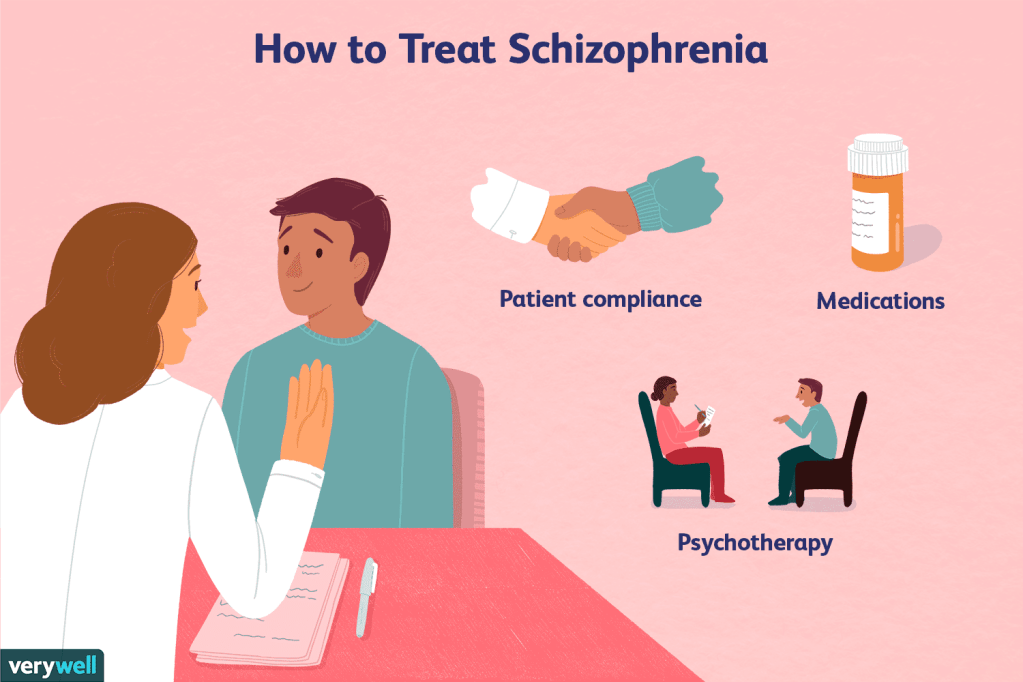
Treatment for Schizophrenia.

Schizophrenia requires lifelong treatment, even when symptoms have subsided. Treatment with medications and psychosocial therapy can help manage the condition. In some cases, hospitalization may be needed.

But there are some strategies used by treatment team which consists of psychologist and social worker work together to help Schizophernia patients.

Here are some of the following strategies used for treatment:

  • Medication:First and Second generation antipsychotic medications are used which manage sign and symptoms with the help of dosage at very low level
  • Example of first level antipsychotic :Chlorpromazine
  • Example of second level antipsychotic :Aripiprazole (Abilify)
  • Long-acting injectable antipsychotics:Some antipsychotics may be given as an intramuscular or subcutaneous injection. They are usually given every two to four weeks, depending on the medication.
  • For adults with schizophrenia who do not respond to drug therapy, electroconvulsive therapy (ECT) may be considered. ECT may be helpful for someone who also has depression.

Hospitalization

During crisis periods or times of severe symptoms, hospitalization may be necessary to ensure safety, proper nutrition, adequate sleep and basic hygiene.

Schizophrenia effect on our daily lives.

I dont feel like doing anything ..What will become of my life”

Many people will say that its our daily life excuse of running away from our daily obligations

But Wait ! For patients with Schizophrenia It takes a different aspect and may go even to lengths of suicide.

“So how does it effect our daily lives”

  • The person is always distressed,have high level of anxiety
  • The person has difficulty in speech fluency and due to society pressure of fluency in language ,the person failing in this task may feel ashamed and may even go to lengths of suicide.
  • The person behaviour ranges from either making new friends at a abnormal rate or complete isolation.As a result the individual is always confused and cant have difficult in decision making.
  • The person has trouble sleeping which in return affects it working capacity
  • Resulting in being not active in work, social relationships deteriorating social and interpersonal domains of a person’s life.
  • As the person’s attention span shifts easily,the person’s quality of work decreases affecting his/her career at times.
  • Having hallucinations and delusions causes the person behave in bizzare way,as a result people avoid having any relationship and exhibits antisocial behaviour.

Schizophrenia effects on our Mental Health.

Is Schizophrenia really dangerous for our health and why does one need to take extra care due to this mental disorder?

Did you know that Schizophrenia is a chronic and severe mental disorder affecting 20 million people worldwide

The major danger health danger that it posseses includes distortions in thinking, perception, emotions, language

Other mental health issues due to Schizophrenia include:

  • The cognitive connection is distorted with brain not functionning to its full capacity where the attention span is very limited.
  • The brain’s noise level rises when the excitatory neurotransmitter glutamate becomes overactive in the prefrontal cortex and at the same time stimulates receptors for another neurotransmitter, dopamine, in the limbic region.
  • Mental fluency and flexibility decreases.
  • Affects the interaction between the centers of judgment and planning in the prefrontal cortex and the centers of emotion and memory in the temporal lobes and limbic system.
  • The limbic system also contains the brain’s reward circuits — the place where we learn what to desire and how to recognize the cues indicating that something desirable is on hand. If patients with schizophrenia often seem to want too little (avolition), it could be the result of malfunctioning in the reward system.

But it should be kept in mind that every individual has symptoms of different level with severity ranging from milder to severe and same diagnosis cant be carried out every individual.

Origin and history of Schizophrenia

So when was Schizophrenia first discovered in history?”

Did you know that the word “schizophrenia” is less than 100 years old.!

Got surprised but there is more box of information related to history and orgin of schizophrenia that will make you even more surprised.

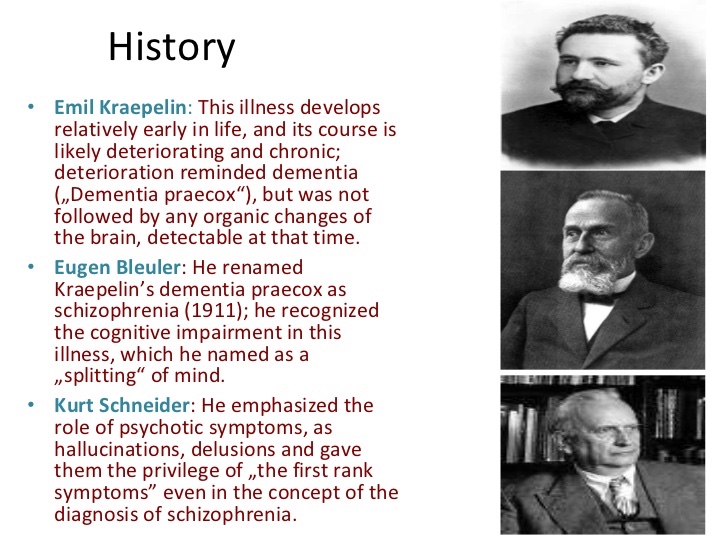
The disease was first identified as a discrete mental illness by Dr. Emile Kraepline in the 1887.

The history and origin dates back to old Pharaonic Egypt.

In ancient Greek and roman times people didnt have any knowlegde of mental disorders and used to categorize people were considered “abnormal” mental disorders under same category without any modern diagnostic method and mostly thought that mental disorders were due to evil force.

Dr. Kraepelin used the term “dementia praecox” for individuals who had symptoms that we now associate with schizophrenia.

In 1887 Dr.kraepline was the first to describe and coin schizophrenia as distinct mental disorder.

The Swiss psychiatrist, Eugen Bleuler, coined the term, “schizophrenia” in 1911. He was also the first to describe the symptoms as “positive” or “negative.”

Both Kraepline and Bleuler categories of Schizoprenia are still used in Dsm 5 which is used by Psychologists around the world.

What is Schizophrenia?

Well many people dont really know what is this really disease about.This is a mental disease which cant be ignored.But we first need to understand what does this complicated mental disorder consist of including its symptoms and causes.

Schizophrenia is a serious mental disorder which inhibits an individual normal functioning.It consists of hallucinations, delusions, and extremely disordered thinking and behavior.

Causes of Schizopernia:

  • combination of genetics,
  • brain chemistry and environment contributes to development of the disorder.
  • Problems in the level of neurotransmitters called dopamine and glutamate.

Symptoms include the following:

  • Delusions:These are false beliefs that are not based in reality.
  • Hallucinations. These usually involve seeing or hearing things that don’t exist.
  • Disorganized thinking (speech). Disorganized thinking is inferred from disorganized speech. Effective communication can be impaired.
  • Extremely disorganized or abnormal motor behavior.This may show in a number of ways, from childlike silliness to unpredictable agitation.
  • Negative symptoms. This refers to reduced or lack of ability to function normally.
Design a site like this with WordPress.com
Get started